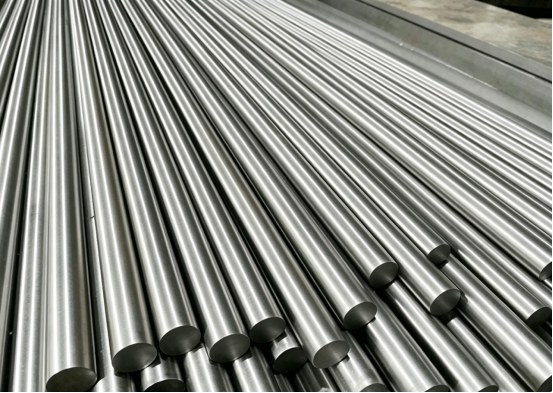
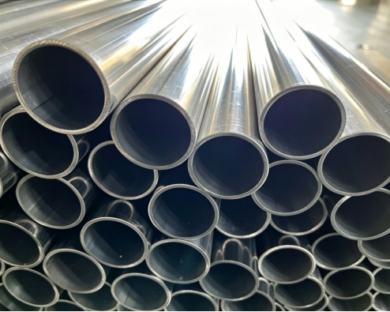
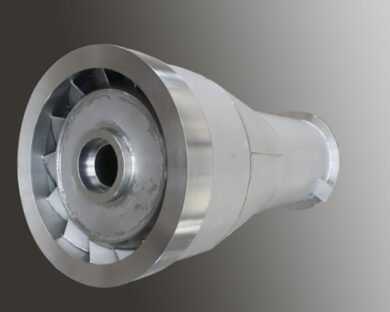
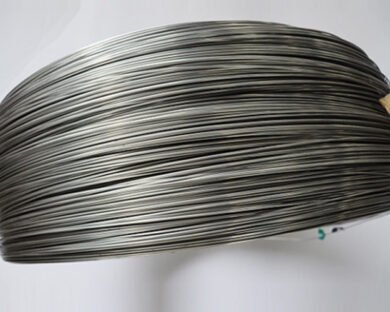
Product Overview: 17-4PH Martensitic Stainless Steel Round Bars
17-4PH is a precipitation-hardening type stainless steel. Its distinctive feature is that it can flexibly switch between “soft” and “hard” through heat treatment. When it is manufactured (in the solution state), its hardness is moderate, making it easy to be processed into various shapes. After forming, it undergoes low-temperature aging treatment, resulting in a significant increase in strength. This “processing first, then strengthening” characteristic makes it a commonly used material for manufacturing high-strength and corrosion-resistant components.
The 17-4PH round bars we supply are in perfect condition – the solutionized state is suitable for processing, while the aged state can be directly put into use. Both states can achieve a balance between high strength and good corrosion resistance. The material fully complies with the ASTM A564 standard and offers various aging hardness options such as H900, H1025, H1075, and H1150, meeting the hardness and toughness requirements for different working conditions.
Application Industries and Product Forms of 17-4PH Martensitic Stainless Steel Round Bars
Applicable operating conditions
Working temperature: Recommended not to exceed 300℃ (572℉), maintaining good toughness even at cryogenic temperatures
Corrosive environment: Exhibits excellent resistance to corrosion in the atmosphere, dilute acids, and salts
Load-bearing requirements: Suitable for high mechanical load conditions
Available Forms and Specifications:
Classification by Surface Condition
| Form |
Status |
| Black Bar |
Hot-rolled bar without pickling or polishing; retains mill scale on the surface; lower cost |
| Bright Bar |
Processed from black bar; features a bright, aesthetically pleasing surface |
| Ground Bar |
Precision-ground; offers high surface finish and dimensional accuracy |
Classification by Processing Method:
Hot-Rolled Bar (HR) Hot-rolled forming
Hot-Forged Bar (HF) Forged processing
Peeled Bar (ST) Surface peeling treatment
Bright Bar (CD) Cold-drawn bright finish
Specification Range
| Parameter |
Range
|
| Diameter |
Φ1.0mm ~ Φ450mm(customization available)
|
| Length |
1m ~ 6m(supplied cut-to-length or in full lengths)
|
Application Industries
| Industry |
Applications |
Recommended Product Forms |
| Aerospace |
Turbine blades, landing gear components, engine fasteners, structural parts |
Ground bars, bright bars |
| Petrochemical |
Pumps and valves, valve stems, high-strength bolts, reactor shafts, load-bearing structures for corrosive environments |
Hot-rolled bars, forged bars |
|
Nuclear
|
Power & Energy Nuclear valve stems, turbine blades, pump shafts, nuclear waste canisters |
Forged bars, large-diameter round bars |
| Marine Engineering |
Offshore platform components, marine drive shafts, subsea valve assemblies |
Black bars, forged bars |
| Medical Devices |
Surgical instruments, surgical tools |
Ground bars, bright bars |
| Food Industry |
Mold components for the food industry |
Bright bars |
| Machinery Manufacturing |
Shafts, gears, bearings, valves, high-strength fasteners |
Hot-rolled bars, peeled bars |
| Automotive Industry |
High-strength structural parts, transmission components |
Hot-rolled bars, bright bars |
Technical Specifications for 17-4PH Martensitic Stainless Steel Round Bars
Specification Range
| Size |
Diameter Range |
Typical Length |
Surface Finish |
| Small Size |
Φ2.0 – 6.0mm |
Coil/Straight Bar |
Bright |
| Standard Size |
Φ8 – 100mm |
3-6m |
Black/Bright/Ground |
| Large Size |
Φ100 – 450mm |
3-6m |
Black Forged/Turned |
Chemical Composition
| Element |
Content Range |
Remarks |
| C |
≤0.07 |
Low-carbon design ensures weldability |
| Si |
≤1.00 |
/ |
| Mn |
≤1.00 |
/ |
| P |
≤0.035~0.040 |
/ |
| S |
≤0.030 |
/ |
| Cr |
15.00 ~ 17.50 |
Basis for corrosion resistance |
| Ni |
3.00 ~ 5.00 |
Ensures martensitic transformation |
| Cu |
3.00 ~ 5.00 |
Key element for precipitation hardening |
| Nb+Ta |
0.15 ~ 0.45 |
Refines grain structure; stabilizes carbon |
Mechanical Properties (Various Aging Conditions)
| Aging Condition |
Aging Temperature |
Tensile Strength σb
(MPa) |
Yield Strengthσ0.2
(MPa) |
Elongationδ5
(%) |
Reduction of Areaψ
(%) |
Hardness |
| Solution-annealed |
— |
— |
— |
— |
— |
≤363HB / ≤38HRC |
| H900 |
480℃ |
≥1310 |
≥1180 |
≥10 |
≥40 |
≥375HB / ≥40HRC |
| H1025 |
550℃ |
≥1060 |
≥1000 |
≥12 |
≥45 |
≥331HB / ≥35HRC |
| H1075 |
580℃ |
≥1000 |
≥865 |
≥13 |
≥45 |
≥302HB / ≥31HRC |
| H1150 |
620℃ |
≥930 |
≥725 |
≥16 |
≥50 |
≥277HB / ≥28HRC |
H900 (Peak-Aged): Offers the highest strength and hardness; suitable for applications with extremely demanding strength requirements.
H1025/H1075: Balances strength and toughness; suitable for components subjected to dynamic loads.
H1150 (Over-Aged): Offers the best toughness and resistance to stress corrosion cracking; suitable for corrosive environments.
Key Advantages of 17-4PH Martensitic Stainless Steel Round Bars
- Tunable Properties – Wide Heat Treatment Window
The most prominent advantage of 17-4PH is its “tunable properties.” By simply adjusting the aging temperature, the final combination of mechanical properties can be precisely controlled across a wide range. After solution treatment, the material is in a soft state (HRC ≤ 38) and easy to machine; subsequent aging treatments at various temperatures allow the hardness to be flexibly adjusted between HRC 28 and 48, offering great flexibility for engineering design.
- Perfect Combination of High Strength and High Hardness
Following precipitation hardening heat treatment, tensile strength can exceed 1310 MPa and hardness can reach HRC 40–48—significantly higher than that of ordinary stainless steels.
- Excellent corrosion resistance
With a chromium content of approximately 17%, combined with alloying elements such as nickel and copper, 17-4PH exhibits superior corrosion resistance in weak acids, alkalis, and atmospheric environments compared to ordinary martensitic stainless steel. Electrolytic polishing and chemical oxidation treatments can further enhance its corrosion resistance.
- Outstanding dimensional stability
During the heat treatment process (especially aging), the dimensional change is extremely small (typically <0.1%), which is crucial for precision parts and large complex structural components.
- Good processing performance
It is easy to machine, drill, and grind in the annealed state, with a high surface finish, making it suitable for the processing of precision instrument parts. The carbon content is low, and its corrosion resistance and weldability are superior to those of ordinary martensitic stainless steel.
Comparison of Life-Cycle Costs: 17-4PH Martensitic Stainless Steel Round Bars vs. Other Common Industrial Metals
Comparison with 304/316 Austenitic Stainless Steels
|
Comparison Criteria
|
17-4PH
|
304 |
316L |
| Strength |
Very high (≥1310 MPa)
|
Moderate (~520 MPa) |
Moderate (~485 MPa) |
| Hardness |
Adjustable (HRC 28-48)
|
Low |
Low |
| Corrosion Resistance |
Similar to 304
|
Good |
Excellent |
| Price |
Higher
|
Low |
Moderate |
| Machinability |
Good (in solution-annealed state)
|
Good |
Good |
Life-Cycle Cost Analysis:
Although the material unit price of 17-4PH is higher than that of 304/316L, it has a more advantageous full-life cost in the following scenarios:
Material reduction benefits: Taking a wind turbine gearbox as an example, after switching from 316L to 17-4PH, the heat treatment is one-time forming, the cutting energy consumption decreases by 23%, the scrap rate significantly reduces, and the overall cost is instead saved by 31%
Life extension: The valve core of oil well downhole tools manufactured with 17-4PH is resistant to H₂S corrosion and has a lifespan 2.4 times longer than ordinary 13Cr steel
Process simplification: The cost of black bars is 15%-20% lower than that of mirror-finished round bars, and after solution treatment, it can obtain high-performance in one-time aging, without the need for expensive forging blanks and complex subsequent processing
Selection suggestions:
Weak to moderate corrosion + ≤300℃ + High mechanical load → 17-4PH, the lowest full-life cost
Strong reducing acid/high chloride ions/wet chlorine gas → Need to select more advanced materials such as Hastelloy alloys
Moderate corrosion but with high chloride ion concentration (such as seawater) → Consider using duplex stainless steel as a compromise solution
Comparison with Hastelloy C276
| Property |
17-4PH |
Hastelloy C276 |
| Material System |
Iron-based |
Nickel-based |
| Tensile Strength |
930-1310 MPa |
≥730 MPa |
| Max. Service Temperature |
300℃ |
~1037℃ |
For moderately corrosive service conditions at temperatures of 300°C or below, the total lifecycle cost of 17-4PH is significantly lower than that of Hastelloy.
Manufacturing Process and Machining Techniques for 17-4PH Martensitic Stainless Steel Round Bars
EAF-VOD + ESR + Forging/Rolling Process:
Raw material preparation → EAF (Electric Arc Furnace) melting → VOD (Vacuum Oxygen Decarburization) refining → Electrode casting → ESR (Electroslag Remelting) → Forging/Hot rolling (billet breakdown) → Heat treatment → Finishing/Inspection → Finished product
Key Process Points:
Melting: Smelted using the EAF-VOD process with strict control over chemical composition.
Electroslag Remelting (ESR): Further enhances steel purity and density.
Forging: Control the finish-forging temperature; anneal promptly after forging to eliminate the risk of cracking.
Heat Treatment Process
The core heat treatment for 17-4PH involves two steps: solution treatment and aging treatment.
Solution Treatment (Condition A):
Temperature: 1020–1060°C
Cooling: Rapid cooling (water or air cooling)
Purpose: To obtain a martensitic matrix; the material is in a soft state, facilitating machining.
Aging Treatment (Precipitation Hardening):
| Condition |
Aging Temperature |
Holding Time |
Cooling Method
|
| H900 |
470~490℃ |
1 hour |
Air cooling |
| H1025 |
540~560℃ |
4 hours
|
Air cooling |
| H1075 |
570~590℃ |
4 hours |
Air cooling |
| H1150 |
610~630℃ |
4 hours |
Air cooling |
FAQ
Q1: What is the maximum operating temperature for the 17-4PH material?
A: In continuous high-temperature working conditions, the recommended long-term usage temperature for this material should be strictly controlled within 300°C. Below this temperature range, its microstructure and mechanical strength can remain stable for a long time; if it exceeds this limit, the material will experience a sharp increase in the risk of brittle fracture due to the continuous precipitation of brittle phases.
Q2: Is this special steel strip magnetic?
A: Yes, it has a distinct strong magnetic property. From a microscopic perspective, 17-4PH belongs to a typical martensitic stainless steel, and the matrix structure determines that it exhibits ferromagnetism in any heat treatment state (whether in solution state or aging state).
Q3: How is the performance of this material in on-site welding? Is it prone to cracking?
A: Thanks to its design with a carbon content of no more than 0.07%, its welding processibility is significantly better than that of traditional conventional martensitic stainless steel.
Q4: What are the essential differences between 17-4PH and the 304 stainless steel we often talk about?
A: They belong to completely different application dimensions. The core differences lie in the following three points:
- Strength discontinuity: After heat treatment, the tensile strength of 17-4PH can soar to 1310 MPa, while conventional 304 is only around 520 MPa.
- Corrosion resistance compatibility: In most marine and chemical weak acid media, the pitting corrosion resistance of 17-4PH is comparable to that of 304.
- Selection strategy: 304 belongs to a universal general rust-proof material with high economy; while 17-4PH has a higher procurement cost and is not resistant to ultra-high temperatures (not exceeding 300°C). It is specifically designed for “high load + strong corrosion” extremely harsh working conditions (such as high-pressure valves, heavy-duty bearings).