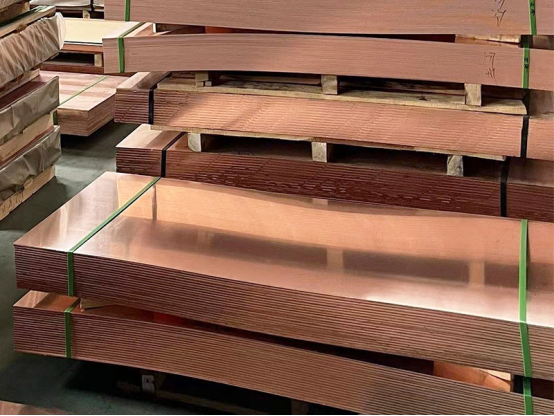
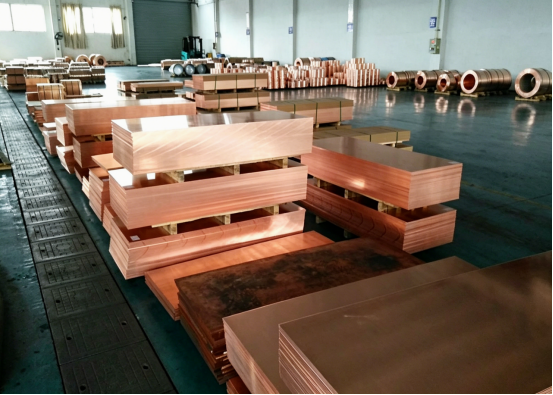
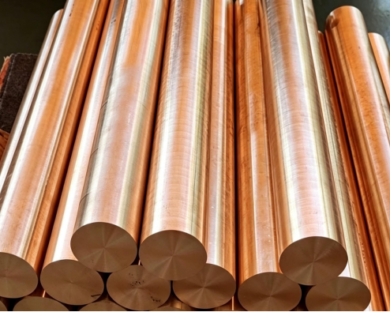
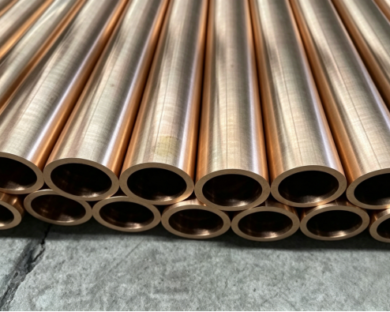
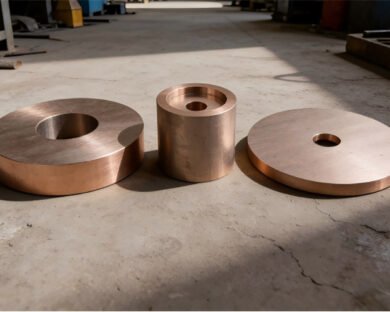
C101 copper, officially known as oxygen-free high-conductivity copper, is a special conductive material with an ultra-high purity copper base. The copper content is at least 99.99%, and the oxygen content is strictly controlled below 0.0005%. It is one of the highest purity grades in the industrial copper system.
C101 copper, with its three core characteristics of ultra-high purity, extremely low oxygen content, and dense and uniform structure, has solved the extreme problem of “hydrogen disease” (hydrogen reacts with copper’s oxides to form water vapor, causing intergranular cracking) that occurs in ordinary electrolytic copper under high-temperature reducing atmospheres. At the same time, it has achieved an industry benchmark level of conductivity exceeding 101% IACS. As a ceiling-level material for conductive and heat-conductive properties, C101 is positioned for high-demand areas such as high-end electrical and electronic, aerospace, precision manufacturing, and vacuum applications. It is the preferred material for radio frequency components, aviation-grade circuits, high-vacuum sealing, and high-power heat dissipation systems.
TIPTOP C101 Copper Alloy Sheet: Applicable Operating Conditions and Industries
| Industry Field |
Typical Applications |
Key Problems Addressed |
Applicable Media / Operating Conditions |
| Aerospace |
Satellite Antennas, Inertial Navigation System Waveguides, RF Connectors, Aerospace-Grade Circuitry |
Ultra-Low Signal Loss, High Thermal Conductivity and Heat Dissipation |
High Temperature (>300°C), High Vacuum, Intense Radiation |
| Electrical Power & Electronics |
High-frequency Transformer Windings, Integrated Circuit Leadframes, Vacuum Tube Electrodes, Switchgear, Busbars, Connector Terminals |
High Current Transmission, Low Resistive Loss |
High Current, High-frequency Signals |
| Electronic Communications |
RF Components, Waveguides, Antenna Assemblies, High-Frequency Connectors, Printed Circuit Boards |
Signal Integrity Preservation, Electromagnetic Shielding, High-Purity Substrates |
High-Frequency Signals, Precision Manufacturing Environments |
| New Energy |
Photovoltaic Cell Conductive Strips, EV Charging Pile Connectors, Power Battery Busbars |
High-Current Transmission, Low Energy Consumption, Long Lifespan |
High Current, Outdoor Environments |
| Precision Machining & Medical Devices |
Cleanroom-Manufactured Components, Precision Instrument Parts, Antimicrobial Surface Components |
Ultra-High Cleanliness Requirements, Natural Antimicrobial Properties |
Cleanrooms, Medical Environments |
| Superconductivity Technology |
MRI Magnet Coils, Particle Accelerator Cavities, Superconducting Magnets |
Cryogenic Superconducting Performance, Extremely Low Resistivity |
Liquid Nitrogen Temperature Range, High Vacuum |
TIPTOP C101 Copper Alloy Sheet: Product Advantages
- Exceptional Electrical Conductivity
With an electrical conductivity of ≥101% IACS—reaching as high as 58.6 MS/m—this material sets the benchmark for electrical performance among currently industrialized pure copper materials. It is ideally suited for applications demanding the utmost signal clarity and minimal electrical resistance.
- Superior Thermal Conductivity
Boasting a thermal conductivity of 391 W/(m·K), it ranks as the best thermal conductor among all materials—surpassed only by silver. Consequently, it is widely utilized in radiators, heat exchangers, and high-efficiency cooling systems.
- Complete Elimination of “Hydrogen Embrittlement” Risk
With an oxygen content of ≤0.0005%, this material fundamentally resolves the issue of cracking that typically affects pure copper when exposed to high-temperature reducing atmospheres. This enables its safe use in reducing environments exceeding 370°C, while also making it an ideal material for high-vacuum applications.
- Excellent Processability and Weldability
With an elongation rate ranging from 30% to 50%, it can withstand complex forming processes such as deep drawing and precision cold working. It is compatible with various joining techniques—including brazing, diffusion bonding, and laser welding—yielding weld seams with strength levels nearly equivalent to the base material; its performance in vacuum brazing applications is particularly outstanding.
- Structural Integrity Ensured by High Purity
With a purity level of 99.99%, the material features a dense, uniform microstructure free of pores, pinholes, cracks, and inclusions. This structural integrity guarantees consistent performance characteristics across all material orientations.
- Outstanding Corrosion Resistance
It exhibits excellent resistance to corrosion across a wide range of environments and possesses inherent antimicrobial properties, making it highly suitable for applications within the medical and food-contact sectors.
Physical and Mechanical Properties of TIPTOP C101 Copper Alloy Sheet
Chemical Composition
| Element |
Content (Typical Value) |
Description |
| Cu |
≥99.99% |
Core Matrix Elements |
| O |
≤0.0005% |
Ultra-Low Oxygen |
| Ag |
≤0.0025% |
Trace Impurities |
| Pb |
≤0.0005% |
Trace Impurities |
| Fe |
≤0.001% |
Trace Impurities |
| P |
≤0.0005% |
Trace Impurities |
Physical Properties
| Density (20°C) |
8.91 ~ 8.94 g/cm³ |
| Melting Point |
1,083 ℃ |
| Electrical Conductivity |
101%(≥58.6 MS/m)% IACS |
| Electrical Resistivity |
0.0171 Ω·mm²/m |
| Elastic Modulus |
115 ~ 117 GPa |
Mechanical Properties (Varying with Heat Treatment Condition)
| Condition |
Tensile Strength(MPa) |
Elongation(%) |
Brinell Hardnes(HB) |
| Soft State (Annealed State M) |
200 ~ 220 |
≥ 30 |
40 ~ 50 |
| Half-Hard State (Y2) |
245 ~ 345 |
≤ 8 |
60 ~ 80 |
| Hard State (H) |
295 ~ 380 |
≤ 3 |
80 ~ 90 |
| Super-Hard State (T) |
≤ 350 |
— |
— |
TIPTOP C101 Copper Alloy Sheet: Manufacturing Process and Processing Techniques
Step 1: Raw material inspection and ingredient addition
Select high-purity cathode copper (≥99.99%), strictly inspect the chemical composition of the raw materials to avoid the introduction of impurities.
Step 2: Vacuum induction melting
Carry out induction melting under vacuum conditions, effectively removing gases and low-melting-point impurities from the molten material, and precisely controlling the alloy composition.
Step 3: Casting
Use semi-continuous or continuous casting processes, casting into ingots under protective atmosphere (or vacuum atmosphere), further preventing oxidation.
Step 4: Hot processing and forming (forging/pressing/heat rolling)
After heating the ingot, it is formed through radial forging or pressing to prepare rods, tubes or plates. Heat rolling to produce thick plate materials.
Step 5: Cold processing
Obtain precision-sized products through cold drawing, cold rolling, cold extrusion, etc.:
Rod: Multi-pass drawing to achieve precise size control
Sheet: Cold rolling to the required thickness, able to provide different hardness according to customer requirements
Pipe: Cold drawing + inner diameter expansion forming
Step 6: Heat treatment
Carry out annealing treatment according to customer requirements.
Step 7: Non-destructive testing
Ultrasonic testing (UT): Detect whether there are cracks, pores, inclusions, etc. in the material, ensuring uniform and consistent internal quality.
Eddy current testing: Suitable for surface and near-surface defects detection of pipes and wire rods.
Step 8: Test performance
Conduct chemical composition analysis, mechanical property tests, conductivity detection, etc., to provide complete material certification documents.
Step 9: Precision processing
Carry out CNC precision processing according to customer drawings, including turning, milling, drilling, etc., to achieve precise final size and tolerance.
Step 10: Surface treatment and inspection packaging
According to requirements, perform acid washing, polishing or electrolytic polishing for surface treatment, and finally inspect for qualification before being wrapped with rust-proof paper, sealed with plastic film, and packaged in wooden boxes for delivery.
Supply Status:
Heat treatment state (Temper)
- Soft/annealed state (O/M): Complete recrystallization annealing, minimum strength, maximum ductility, suitable for deep stamping and complex forming processing
- 1/4 hardened state (1/4H/Y4): Mild cold working, balancing certain strength and formability
- 1/2 hardened state (1/2H/Y2): Medium strength, suitable for general structural components
- Hard state (H/Y): Higher strength, maintaining good ductility
- Super-hard state (HH/T): Highest strength state, suitable for applications with high strength requirements Surface treatment:
- Pickling surface: Remove oxide scale, presenting the original copper color
- Precision peeling/ polishing surface: Ra ≤ 0.8 μm, suitable for high-precision mating
- Bright annealing surface: Oxygen-free atmosphere protected annealing, with a bright and clean surface
- Electrolytic polishing: Ra can be reduced to < 0.5 μm, suitable for RF and electronic components
Applicable ASTM Standards and Quality Inspection System for TIPTOP C101 Copper Alloy Sheet
| Standard |
Scope of Application |
| ASTM B152 |
Copper Sheet, Strip, Plate, and Rolled Bar |
| ASTM B170 |
Oxygen-Free Electrolytic Copper — Refined Castings |
| ASTM B75 |
Seamless Copper Tube |
| ASTM B111 |
Seamless Copper and Copper Alloy Condenser Tubes |
| ASTM B188 |
Seamless Copper Tubing |
| ASTM B447 |
Welded Copper Tube |
| ASTM F68 |
Oxygen-Free Copper (Electronic Grade) |
| MIL-T-24107B |
Military Specifications — Copper and Copper Alloy Tubing |
Quality Inspection System:
ISO 9001:2015 Quality Management System Certification
CNAS/CMA Third-Party Testing Accreditation
End-to-End Traceability Management: Step-by-step tracking from raw materials to finished products.
TIPTOP METAL’s Company Advantages
As a professional supplier of copper alloy materials, our company, with profound technical expertise and a comprehensive quality management system, offers customers comprehensive solutions for high-performance C101 oxygen-free copper products.
- Full-process quality control
Implement a full-process quality traceability system from raw material entry to product completion, ensuring that each batch of products meets the strict standard of C101 purity (Cu ≥ 99.99%). Provide complete material certificates and test reports.
- Multi-form and full-variety supply capability
We have a wide range of products including sheets, rods, tubes, strips, wires, and forgings. The regular thickness of sheets covers 0.08mm to 50mm, and the outer diameter of tubes ranges from 1mm to 67mm. We support customized non-standard specifications.
- Precision processing supporting services
Equipped with advanced CNC processing centers, we can provide “one-stop” services from raw material supply to finished parts, meeting customers’ ultimate pursuit of dimensional accuracy and delivery cycle.
- Third-party authoritative testing guarantee
We can entrust third-party testing institutions with CMA/CNAS qualifications to conduct testing projects such as ultrasonic flaw detection, mechanical performance testing, and chemical composition analysis, ensuring that the products meet the requirements of international standards such as ASTM, EN, and GB.
- Professional technical support team
A team of senior material engineers provides customers with full-process technical support services such as material selection consultation, processing process optimization, and application problem diagnosis.
- Global supply chain and flexible delivery
Relying on a complete supply chain system and efficient logistics network, we support various delivery methods such as air freight, sea freight, and express delivery, meeting customers’ diverse demands for delivery timeliness.