What Is a Duplex Stainless Steel Guide Vane?
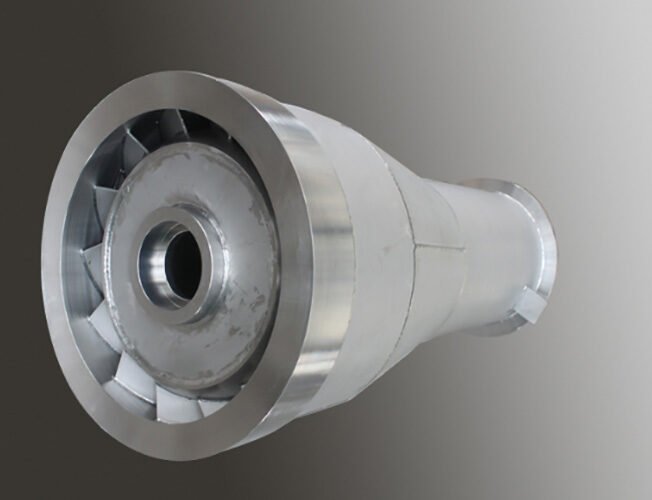
A duplex stainless steel guide vane is one of the major parts inside pumping machinery such as axial flow pumps, mixed flow pumps, and multistage centrifugal pumps. Usually, it is placed right after the impeller to direct the flow of liquid and to enhance flow stability.
Most commonly this part is made of duplex stainless steel – a metal having a microstructure that is a mix of austenite and ferrite phases. Duplex steel grades possess elevated strength levels and superior corrosion resistance to chlorides when compared to ordinary stainless steel grades such as 304 or 316, hence these qualities make them highly suitable for complex fluid handling systems.
Why Use Duplex Stainless Steel for Pump Guide Vanes?
Duplex stainless steel contains the best features of both austenitic and ferritic stainless steels, thereby making pump components a perfect application for it, especially when these components get exposed to multifaceted operating conditions.
High Strength with Reduced Weight
Duplex stainless steel exhibits nearly double the yield strength of standard austenitic stainless steel. In the context of pump design, this results in saving on materials by facilitating thinner walls that still maintain the required level of strength. This is an added advantage of using duplex stainless steel as it results in less material consumption and component weight reduction.
Excellent Corrosion Resistance
There are many reasons that duplex stainless steel is a more preferable choice than the traditional materials (304 and 316), most notably its resistance to chloride stress corrosion cracking.
It also protects the materials in cases of:
- Pitting corrosion
- Crevice corrosion
- Exposure to seawater and other chloride environments
Due to this, it is often utilized in marine pumps, chemical pumps, and desalination plants.
Good Toughness and Weldability
Duplex stainless steel grades have higher toughness than ferritic stainless steels. Usually, these steels can be welded without preheating and in most cases post-weld heat treatment is not required which results in simplified fabrication.
Compatible Thermal Expansion
The value of the thermal expansion coefficient for duplex stainless steel is similar to that of carbon steel. Therefore, it can be employed in composite structures or assemblies where different materials are joined.
Common Duplex Stainless Steel Grades
The most common materials used for guide vanes manufacturing are:
- UNS S32304 (23Cr-4Ni-0.1N)· UNS S31803 / S32205 (22Cr-5Ni-3Mo-0.15N)· UNS S32550 (25Cr-6Ni-3Mo-2Cu-0.2N)
Choosing the material mainly depends on the service conditions, especially chloride content and pressure.
Structural Design and Features of the Guide Vane
Conical Flow Channel Structure
The guide vane generally takes the form of a cone. Its one end features a big diameter with attached guide blades whereas the opposite end tapers gradually in size.
A central hole goes through this part which means that it can be fixed on a shaft or joined with downstream parts.
Radial Guide Blade Arrangement
The internal blades are positioned evenly in a radial formation. Their aerodynamic shape helps in decreasing turbulence and also ensures that fluid can move at high speeds without any difficulty.
Both surface finish and the accuracy of machining are critically important in flow resistance reduction and efficiency enhancement.
Functions of the Pump Guide Vane
Flow Straightening and Energy Conversion
Fluid exiting the impeller often carries rotational energy. The guide vane converts this rotational kinetic energy into static pressure while removing swirl, allowing the fluid to move in a more stable axial direction.
Diffusion and Pressure Recovery
The tapered flow channel slows down the fluid velocity and gradually increases pressure. This reduces hydraulic losses and improves the overall efficiency of the pump or fan system.
Mechanical Connection Function
The central hole is used for shaft passage or connection to the next stage impeller or piping system. The flange surface is typically used to connect with the pump casing or housing.
Typical Applications
Duplex stainless steel guide vanes are widely used in fluid equipment where both efficiency and corrosion resistance are required.
Pump Systems
Axial flow pumps
Mixed flow pumps
Multistage centrifugal pumps
They are usually installed at the impeller outlet and play a key role in pressure build-up and flow stabilization.
Industrial Fan Systems
Guide vane components are also used in large ventilation systems, such as:
Mining ventilation
Tunnel airflow systems
Power plant air handling
Corrosion-Resistant Fluid Equipment
Due to their material properties, these components are also suitable for:
Chemical process pumps
Seawater desalination systems
Marine engineering equipment
Manufacturing and Machining Considerations
The guide vane is a precision-machined component that requires strict control over geometry and surface quality.
Typical production steps include:
Material forging or casting (depending on design)
CNC machining for internal flow channels and blades
Surface finishing to reduce flow resistance
Dimensional inspection and balance checking
Material testing and inspection can be carried out based on project requirements.
Why This Component Matters in Pump Performance
In many pump systems, the impeller gets most of the attention, but the guide vane is just as important.
Without proper flow guidance and pressure recovery, even a well-designed impeller cannot achieve optimal efficiency. A well-machined duplex stainless steel guide vane helps ensure stable operation, improved energy efficiency, and longer service life in demanding environments.